Musculoskeletal Models
The human musculoskeletal (MSK) model is the msk of an environment spec and comes from myo_sim. Each leg model is composed at runtime, so an MSK key resolves by a call to myo_sim.load_spec(<model>). For myolegs26, myolegs, and myofullbody, the assist_sim key matches the myo_sim model name. myolegs22 is the exception: it loads the myo_sim myolegs26 model and then reduces it to 22 muscles.
| Key | Base nq | Description |
|---|---|---|
myolegs26 | 47 | 26-muscle, passive torso and legs. |
myolegs22 | 39 | Planar 22-muscle. A sagittal-plane reduction of myolegs26. |
myolegs | 35 | 80-muscle, passive torso. |
myofullbody | 123 | Full body: torso muscles, arms, and legs. |
The muscle count and the 2D or 3D control mode come from the msk key. You do not set them separately.
Keyframes
Only myolegs22 ships keyframes. For the other three keys, a device combination adds the same five poses, so every combined leg model has five keyframes and a device config’s keyframe_overrides applies to all four keys:
| Key | In the base model | After a device combination | keyframe_overrides |
|---|---|---|---|
myolegs22 | 5 | 5 | applies |
myolegs26 | none | 5, added | applies |
myolegs | none | 5, added | applies |
myofullbody | none | 5, added | applies |
The five poses are stand, walk_left, walk_right, squat and lunge. The walk_left and walk_right poses also carry a 1.5 m/s forward velocity.
load_msk returns the base model and runs no combination, so it gives no keyframe for three of the four keys. Use load_combined to get the poses.
myolegs26

myolegs26 is the base 3D model: 26-muscle legs under a passive anatomical torso.
- Torso. A passive torso scaffold (spine, ribs, head; no arms, no torso muscles) is rigidly attached to the legs.
- Free-root base. The root is a
freejointon the torso scaffold. - No keyframe in the base model. On its own the model loads at
qpos0, the assembled standing pose, and floats a small distance above the ground. A device combination adds the five poses.
myolegs22 (planar reduction)
myolegs22 is a planar, sagittal-plane reduction of myolegs26.
- Planar root. The root is three sagittal-plane DOFs:
pelvis_tx(fore-aft),pelvis_ty(vertical), andpelvis_tilt. - Reduced from 26. The frontal-plane hip DOFs (
hip_adduction,hip_rotation) and theabd/addmuscles are removed to go from 26 to 22 muscles. The torso is kept. - Keyframes. It ships five keyframes:
stand,walk_left,walk_right,squat, andlunge. They remain after a device combination, and the pipeline removes the slot of any joint that the device surgery removes.
myolegs (80-muscle)
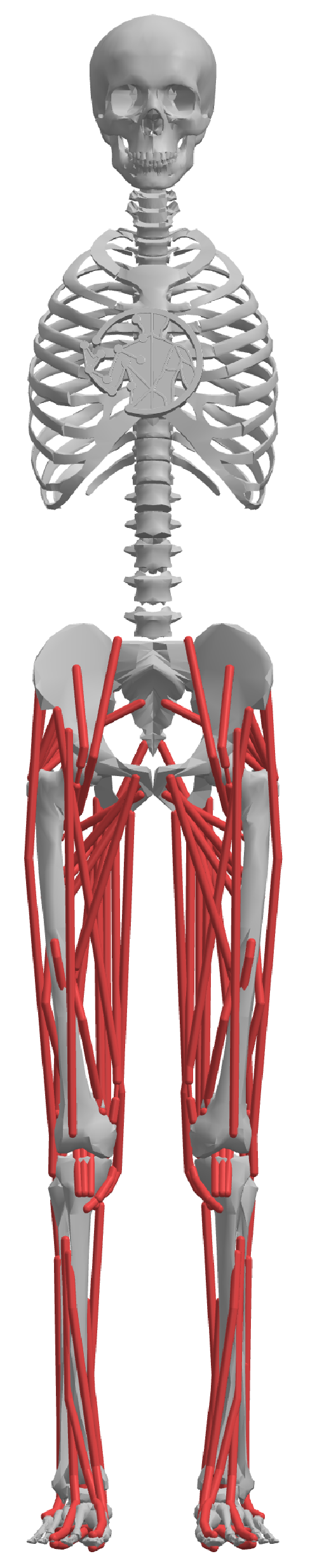
myolegs is the 80-muscle lower-limb model: the highest muscle fidelity for the legs, over the same passive torso scaffold as myolegs26.
- Torso. Passive torso scaffold, so torso-targeting devices work on it.
- Free-root base. Like
myolegs26, the root is afreejoint, so a device keyframe override that targetspelvis_tyis skipped. See Root frame. - No keyframe in the base model. On its own it loads at
qpos0, and floats a small distance above the ground. A device combination adds the five poses. - Requires
mujoco>=3.4,<3.5, the same as every other MSK key. The standalone sibling packages (assist_sim,myoassist-terrains) may build on a wider MuJoCo range; check those repositories if you install a sibling on its own.
myofullbody (full body)
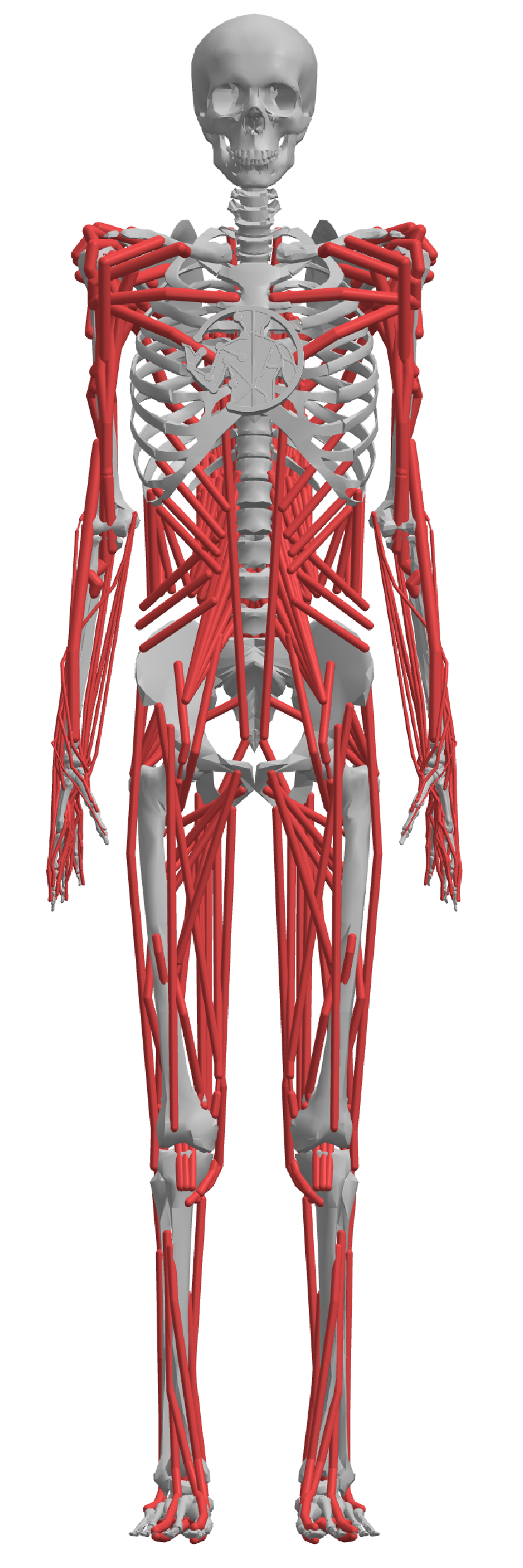
myofullbody is the most complete human model: torso muscles, arms, and legs (123 base DOFs). Use it for whole-body studies, or when a device or task involves the trunk or arms.
- Requires
mujoco>=3.4,<3.5, the same as every other MSK key. - Every device also composes with it, because it shares the same torso attachment scaffold. See the Device Catalog.
- Free root, no keyframe in the base model. The same as
myolegs26. A device combination adds the five poses. - Do not cache it. The model is large, so a cache hit is slower than a fresh build. See Exporting & Loading.
Root frame
myolegs22 has a planar root: three named sagittal DOFs, which are pelvis_tx (fore-aft), pelvis_ty (vertical) and pelvis_tilt. The other three keys have a freejoint root, which is the myosuite convention.
The difference shows in two places:
- A device
keyframe_overridesentry that targetspelvis_tyapplies onmyolegs22. On a free-root model the pipeline skips that entry and gives no message, because the joint does not exist. - The reflex controller reads the pelvis state from those named DOFs.
The controller-optimization path therefore reframes a free-root model. It replaces the freejoint with the same three named DOFs before the device attaches. This is automatic when you give myolegs26 or myolegs to train.py, so the reflex controller works on the 3D lineage. See Running Optimizations.
The reinforcement-learning path keeps the freejoint, because a 3D policy controls all six root DOFs.
One MSK key can thus load with a different root in the two paths. The muscles, the device and the mass properties do not change.
Adding a new MSK model
The MSK models live in myo_sim, not in this repository. assist_sim supports the four curated keys above and resolves them through myo_sim. There is no pattern to load an arbitrary MSK XML from a path, because the device pipeline depends on per-MSK conventions, such as the frame orientation and the joint, tendon, and site names.
To add support for a new MSK model, do two steps:
- Contribute the model upstream to
myo_sim, somyo_sim.load_spec(<name>)can return it. - Register the key in
assist_sim, and add a per-MSK override block to each device that needs one (see Per-MSK Overrides).
To modify existing musculoskeletal models, they can be exported with or without an associated device through the assist_sim package, and modified manually once exported.
See Contributing to get started, or open an issue on the myo_sim or assist_sim repository.
See Defining an Environment for how to pair an MSK with a device and a terrain.